The word “confidence” has been
swirling around my mind the last few days.
Do we really trust God? Do we
really, consciously, rely upon him? I
think we would all say “yes.” It was
quite frequent, when I was working as a window clerk for the Postal Service,
upon greeting a person who had professed belief in God, that the person would
respond something to the effect, “I’m doing fine because I’m on this side of
the earth and not six feet under.” We
have “confidence” because we are alive or in relative good health, but that is
not actually confidence. We think we do
trust and rely upon God to keep us out of hell.
I think that is the main thing we are concerned about. We don’t mind if we don’t live as saints here. We do what we think is necessary to attain
salvation, and God will “clean” us up in Purgatory—if the person even gives
thought to this. Mostly, if we think
about it, most of our “confidence” lies in us.
It is what I think, what I believe.
There are also those who work to “elevate”
themselves, to make themselves ascend, attempting to make themselves saints or,
alternatively, place confidence in the good works they are doing. These words keep coming to mind, “…Many, I tell you, will attempt to enter
but will not be strong enough.”[1] It is absolutely necessary to do good works
because, without good works, God is not working through us. Good works is the evidence that God is doing
a good work. However, we cannot place
confidence in the works that we do. God
also utilizes non-believers, and they will also do good things. It is for this reason that St. Paul tells us,
“Work out your salvation with fear and
trembling, in order that we might not fall into the trap of thinking we are
earning something, elevating ourselves, because of the works themselves.[2] Archbishop John MacEvilly explains: “Because,
as their salvation does not depend on themselves but principally on God’s
grace, they should tremble, lest God, in punishment of their sins, would
withhold his grace and leave them to their ruin. In this verse is contained a proof of the admissibility
of grace. He says, ‘that it is God that
worketh,’ because the grace of God is the principal cause in the production of
good works, although human liberty also has its share, and it is usual in
Scriptures to ascribe an effect to the principal
cause, although subordinate causes
also may concur in its production. That
human liberty is not here denied is clear from the exhortation of the Apostle
in the preceding verse, for why work
out their salvation with fear and trembling if in the work they had no free
agency?”[3]
Archbishop Luis Martinez, as I have
alluded to a previous article, explains: “The spiritual life is indubitably a
continual ascent, since perfection consists in union with God and God stands
above all creation. To arrive at God, we
must ascend, but the paradox that I emphasize lies in this: that the secret of
ascending is to descend. St. Augustine,
in his inimitable style, thus explains this paradox: ‘Consider, O brethren,
this great marvel. God is on high: reach
up to Him, and He flees from you; lower yourself before Him, and He comes down
to you’ (St. Augustine (354-430; Bishop of Hippo), Sermo 2, de Ascensione). St. John of the Cross picturesquely teaches
the same in the title page of his book The Ascent of Mount Carmel, from
which I take only these lines: ‘In order to come to be all, desire in all
things to be nothing’ (St. John of the Cross (1542-1591; Spanish Carmelite
mystic, and reformer of the Carmelite Order), Ascent of Mount Carmel, Bk. 1,
ch. 13, line 11).”[4]
We are like a person at the
beach. The water is so beautiful, and
the sound of the waters is so calming. They
beckon us to enter. Standing on the
shore, we can say that we have confidence in the water, but we do not. We can wade out into the water to a point up
to our chest, and say we have confidence in the water; however, we do not. In order to gain confidence in the water, we
must enter those waters to a point where the water comes above our mouth and
nose. If we have confidence in the
water, the water will support us, keeping us aloft. However, that which supports us will also
kill us if we have no confidence in it or if we become weary. We can say we won’t get weary, but the truth
is: We will become weary, and we will
die.
God
doesn’t tell us to pray always just to throw his “weight” around, having us to
do something just for the sake of ordering us about. Our very existence depends upon God. He has us pray because we must constantly be
aware that he is the cause of us being alive, that we rely upon him continuously. It is something that we know; however, we do not live as that is what we believe.
We think, “God knows that I know that; therefore, I’m good to go.” This is the beginning stage of becoming
weary. We know it, but we do not
believe it, rely upon it, to the point where we depend upon it, crying out
because we cannot stop ourselves from becoming weary and need someone to
support us. Without me you can do nothing.[5] Sin is nothing.
Commenting upon John 1:3, St.
Augustine teaches: “Give good heed to what follows, brethren, ‘All things were
made by Him, and without Him was nothing made,’ so as not to imagine that ‘nothing’
is something. For many, wrongly
understanding ‘without Him was nothing made,’ are [inclined] to fancy that ‘nothing’
is something. Sin, indeed, was not made
by Him; and it is plain that sin is nothing, and men become nothing when they
sin.”[6] Sin is outside of God; therefore, all we can
do without God is sin. In order to do
something or be something, we need God.
In order to keep this in remembrance, we need to pray. Prayer reminds us that we are nothing without
God. Jesus prayed not only to give us an
example; he prayed also because, as man, he needed to. If he did not have a need to pray, he would
not have been man; he would have only been divine. I love how Archbishop Martinez puts it: “We
think, perhaps, that transformation in Jesus is something that we can achieve
with God’s help. But no. Simply having God’s help is not sufficient. God alone can accomplish it, and the only help
that we can give Him is to allow Him a free hand, not to impede Him.”[7]

We avail ourselves to God for the
purpose that he may use his hammer and chisel to form us. This entails suffering. We must avail ourselves to suffering at all
times, without complaint. We must become
willing sufferers, having confidence that God is molding us, shaping us. Hear the words that we read God spoke to St.
Catherine of Siena: "A different reward is received by the soul who
perceives only My will, which, as has been said, wishes nothing else but your
good; so that everything which I give or
permit to happen to you (emphasis added), I give so that you may arrive at
the end for which I created you.”[8] He goes on to tell her: “Wherefore, in order
to arrive at purity, you must entreat Me to do three things: to grant you to be
united to Me by the affection of love, retaining in your memory the benefits
you have received from Me; and with the eye of your intellect to see the
affection of My love, with which I love you inestimably; and in the will of
others to discern My will only, and not their evil will, for I am their Judge,
not you, and, in doing this, you will arrive at all perfection.”[9]
Desolation is part of this suffering
that we must endure when we avail ourselves to God. Remarking upon desolations, Archbishop
Martinez teaches us: “Another advantage of spiritual dryness is that it
produces a deep and true humility in us. When we hear a sermon on humility, or read a
spiritual treatise, or meditate seriously, we come to the conclusion that we
are very miserable beings. But this
conviction is no more than theoretical. When we are told that there are torrid
regions in Africa, and that the temperature is oppressive, and that traveling
is difficult and painful in those desert areas, we form some idea of those
torrid climates. But what a difference
there is in hearing about all this and in going there and suffering from the
heat and feeling all its effects in our body!
The same thing occurs with humility. To be given theoretical knowledge of our
misery is quite different from feeling it, coming in contact with it, and
knowing it by experience. And in
desolations, we feel our helplessness and misery in such a way that when we
have thus perceived it, we never forget it…
[D]esolation shows us truly that we are incapable of having a good
thought or a pious affection… Furthermore,
with desolation come struggles and temptations; and the worst feelings well up
in our heart. At such a time, the soul
thinks, ‘My life has been a deception. I thought I had achieved some virtue; I
thought I knew how to pray. But I have
accomplished nothing. All is a
deception. For me, all is lost.’ Is not this to realize our miserable
condition? What a difference between
describing it and feeling it! In this
way, desolations exercise us in the life of faith; they detach us from the
spiritual gifts of God, and they produce in us a deep understanding of
ourselves, a great fund of humility. Are
not these great advantages enough for us to come to an appreciation of
desolation? How could we ever obtain
them by means of consolations in that pleasant and easy life we dreamed
of? So, let us be reconciled to trials,
for they are a most important factor in the spiritual life: they have their
beauty, they are fruitful, and they possess incomparable advantages.”[10]
As I alluded to earlier: It is a very
difficult thing for us to avail ourselves to God because of the pride within us. Pride fights back, demanding to be respected,
demanding to be somebody, demanding to defend ourselves. We were formed from dirt. We cannot keep ourselves alive. Dirt is dirt.
Dirt cannot make itself fertile.
It must depend upon an outside force.
Therefore, whenever someone’s evil will cause us suffering, we must see
it as God desiring it to be done to us, as part of his hammer and chisel, in
order to shape us into the likeness of his Son, in order to make us “fertile,”
just as he did King David. Consider the
words of the king when he was fleeing his son, Absalom, and Shimei was cursing
him and throwing rocks at him: “Let him
alone, and let him curse; for the Lord has bidden him. It may be that the Lord will look upon my
affliction, and that the Lord will repay me with good for this cursing of me
today.”[11] Keep, also, the words of Joseph close to our
hearts, the words he spoke to his brothers: “As
for you, you meant evil against me; but God meant it for good, to bring it about that many people should be kept alive,
as they are today.”[12] Also,
we have the example of our Lord: He was
oppressed, and he was afflicted, yet he opened not his mouth; like a lamb that
is led to the slaughter, and like a sheep that before its shearers is dumb, so
he opened not his mouth. By oppression
and judgment, he was taken away; and, as for his generation, who considered
that he was cut off out of the land of the living, stricken for the
transgression of my people? And they
made his grave with the wicked and with a rich man in his death, although he
had done no violence, and there was no deceit in his mouth. Yet it was the will
of the Lord to bruise him; he has put him to grief... [13] In the Acts of the Apostles, we have Philip
also quoting these words: In his
humiliation, justice was denied him.[14] Although justice was denied
our Lord on this earth, nevertheless, justice was not denied him by the Father
and he was rewarded, to bring it about
that many people should be kept alive.
The misadventures which occur to us is not for our benefit only, but also
for the benefit of others. Hear the
words of the author to the Hebrews: In
the days when he was in the flesh, he offered prayers and supplications with
loud cries and tears to the one who was able to save him from death, and he was
heard because of his reverence. Son though he was, he learned obedience from
what he suffered; and when he was made perfect, he became the source of eternal
salvation for all who obey him…[15] Holy Scripture tells us that Jesus’ prayers
were answered—his prayers were answered although he still underwent his Passion
and Crucifixion. He learned obedience from what he suffered and … was made perfect.
Not only are we like rocks with
minds, we are also like clay with minds.
This is because we were formed from the dirt of the ground and God
breathed life in us. With our minds, we
are to understand how utterly dependent we are upon God and see all the gifts
he has given to us—who are dirt. As I
mentioned previously, dirt can do nothing of its own; it is entirely dependent
upon an outside force. For us, that
outside force is God, our Creator and Redeemer.
We are to see this and be thankful.
To not be thankful is to believe that, one, it was owed to us or, two,
we accomplished it ourselves. “Woe to him who strives with his Maker, an
earthen vessel with the potter! Does the
clay say to him who fashions it, ‘What are you making?’”[16]
Then
the word of the Lord came to me (Jeremiah): “O house of Israel, can I not do with you as this potter has done?
says the Lord. Behold, like the clay in
the potter’s hand so are you in my hand, O house of Israel. If at any time I declare concerning a nation
or a kingdom that I will pluck up and break down and destroy it and if that
nation concerning which I have spoken turns from its evil, I will repent of the
evil that I intended to do to it. And,
if at any time I declare concerning a nation or a kingdom that I will build and
plant it and if it does evil in my sight, not listening to my voice, then I
will repent of the good which I had intended to do to it.”[17] These
words are to keep us from being presumptuous.
This tells us that we can lose our salvation. This tells us fatal—double—predestination is
error.
Let us first realize the fact that
pride is in us, and may that realization cause fear in us. It is that pride that will cause us to become
weary or to lose confidence in God. We
cannot be prideful and humble. Pride
will allow us to think that we are humble in order to exalt itself. Humility is no pride. One is either prideful at all times or is
humble at all times. We cannot make
ourselves humble because humility is something and we can only do nothing
without God. Dirt cannot eliminate the
stones in it; an outside force must eliminate the stones. Because we are prideful, we cannot eliminate
pride by our own strength; we must look to an outside force to eliminate pride
in us: God. However, we must pray that
he does it, ask that he does it. We cannot
eliminate the pride within us; we can only sin of our own strength.

The
word that came to Jeremiah from the Lord: “Arise, and go down to the potter’s
house, and there I will let you hear my words.” So, I went down to the potter’s house, and
there he was working at his wheel. And
the vessel he was making of clay was spoiled in the potter’s hand, and he
reworked it into another vessel, as it seemed good to the potter to do. Then the word of the Lord came to me: “O house
of Israel, can I not do with you as this potter has done? says the Lord. Behold, like the clay in the potter’s hand, so
are you in my hand, O house of Israel. If
at any time I declare concerning a nation or a kingdom that I will pluck up and
break down and destroy it and if that nation concerning which I have spoken
turns from its evil, I will repent of the evil that I intended to do to it. And, if at any time I declare concerning a
nation or a kingdom that I will build and plant it and if it does evil in my
sight, not listening to my voice, then I will repent of the good which I had
intended to do to it. Now, therefore,
say to the men of Judah and the inhabitants of Jerusalem: ‘Thus says the Lord,
Behold, I am shaping evil against you and devising a plan against you. Return, everyone from his evil way, and amend
your ways and your doings.’ “But they
say, ‘That is in vain! We will follow our own plans, and will every one act
according to the stubbornness of his evil heart’.”[19]
God creates us for specific
purposes. Nonetheless, as the passage
above tells us, we are able to change what is destined for us. He raised up Israel for good; however, when
Israel turned away, God sent them into exile.
God raised up Assyria to punish Israel.
Nevertheless, when Neneveh repented, they were spared. Later, when they returned to their evil ways,
they were destroyed. It is God’s will
that all men should be saved (1 Ti 2:4); however, we can change our
destiny. We must want what God wants; we
must desire to be like him. We cannot
desire God of our own strength. He must
make us to desire him, either directly or indirectly—through others.
You
will say to me then, “Why does he still find fault? For who can resist his
will?” But who are you, a man, to answer back to God? Will what is molded say to its molder, “Why
have you made me thus?” Has the potter no right over the clay, to make out of
the same lump one vessel for beauty and another for menial use?[20] For
when a potter kneads the soft earth and laboriously molds each vessel for our
service, he fashions out of the same clay both the vessels that serve clean
uses and those for contrary uses, making all in like manner; but which shall be
the use of each of these the worker in clay decides.[21]
Love and suffering go
hand-in-hand. I recall the times my wife
and I had to be separated because of my overseas tours. How I longed for her. This is a type of suffering. This is a type of suffering we should have
for God. It could be asked, “Why would
we long for God when he is within us?”
Because of the sin within us, we cannot see him “face-to-face.” That closeness is with us; therefore, we long
for this to be the case. This is not
something that we can conjure up within ourselves. We have this “suffering” when we detest those
things in us that are contrary to God.
We must be asking God to allow this “suffering” in us in order that we
may desire to be, and become, more and more into his likeness.
Confidence, like faith, will grow at
times and, seemingly, diminish at times.
This must be the case. It keeps
us crying out to God. There needs to be
consolations and desolations. If this
was not so, there would be no desolations, no sufferings. It is the desolations and sufferings that
will perfect our love of God. It is these
which will strengthen our trust. I say “seemingly”
because, in actuality, God is causing our confidence to increase. Archbishop Luis Martinez writes: “No matter
how close or perfect or intimate may be [the] union of God with the soul, it is
not yet the consummated union of eternity; and everything that is lacking in
this union on earth and that prevents it from attaining the perfection that the
union in Heaven possesses necessarily becomes sorrow that is mysteriously mixed
with joy. This sorrow is something sweet
and bitter at the same time, nevertheless a sorrow of a special kind that
surpasses in intensity all other sorrows. It is the more intense by how much more it is
pure, by how much more it is spiritual, and by how much more it is profound. Love is insatiable. It is satisfied only with the infinite,
satisfied only when it is possessed in that most perfect manner that is proper
to Heaven. Everything else serves but to
excite desire and to convert it into a martyrdom. In the degree that anyone possesses God, he
desires Him more; and the more intimate the union, the more terrible is the
martyrdom of desire.”[22]
However, on the negative side: as in
the case of faith, confidence can erode.
If we are not looking at desolations and sufferings with the eyes of
faith, both faith and confidence will diminish, and can diminish to the point
of loss of salvation. The archbishop goes
on to say: “Beloved, the fact that Jesus accomplished the supreme manifestation
of love on the blessed Cross should be sufficient for the souls who love Him to
make them perceive the imperious necessity of suffering for Him, of giving
themselves over to sorrow, of being overwhelmed with grief, and of being ground
like wheat and pressed like grapes in the winepress in order to be converted
into the food and drink of love, into a living Eucharist for the best Beloved.
… It is the nature of love to transform those who love, to the point of uniting
them one to another in a certain manner. The words ‘to have but one heart and one soul’
are not mere hyperbole; they express a mystery of unity that all love achieves,
since it causes those who love one another to have the same thoughts and the
same affections, so that their joys and their sorrows are shared in common. … The
divine fruit of union is, therefore, transformation, the effecting of unity. Jesus lives in us, and we in Him. All that belongs to Him is ours, and all that
belongs to us is His; His joys are our joys, and His sorrows are our sorrows. Our acts become divine, and Jesus renews in us
the mysteries of His life. Among all the
things that Jesus communicates to us and shares with us when we are transformed
in Him, the foremost are His sorrows, His Sacrifice; for His sorrows are most
dear to Him, and Sacrifice was the supreme act of His life. Avid of suffering, since His sufferings give
glory to the Father and since they are the fountain of life for souls, Jesus
did not remain content with the sufferings of His mortal life, but He wishes to
continue them until the end of time in the Eucharist and in souls. To the blessed souls who become one through
love and are transformed in Him, He shares His divine sufferings, His intimate
sorrows, in order that He may continue suffering in them, as His insatiable
desires demand, and in order that those souls might have divine sufferings
whereby they may in due measure be glorifiers of the Father and redeemers of
souls. And here we touch upon the
supreme secret of sorrow, a glimpse of which demands that we forsake the earth
and plunge our spirit into the bosom of God.”[23]
When we endure desolations and
sufferings with an eye of faith, we will have confidence and will not become
weary. It is then that the “waters,” the
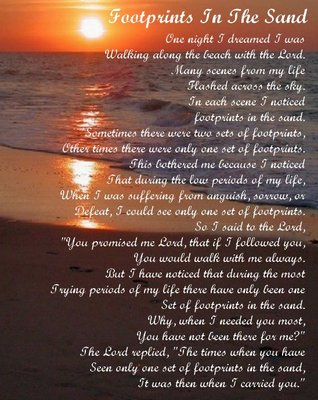
Holy Spirit will do all the work and keep us afloat. It is just as in the beautiful poem “Footprints
in the Sand.” The man was suffering;
and, during the suffering, he only saw one set of footprints in the sand. The Lord said, “It was during those times
that I carried you.” Although the Lord
carried him, he still suffered because suffering is necessary. It was not that the helped him; he was
carrying him, yet allowed him to feel the suffering.
I will conclude with the words of
St. Paul: That I might not become too
elated, a thorn in the flesh was given to me, an angel of Satan, to beat me, to
keep me from being too elated. Three
times I begged the Lord about this, that it might leave me, but he said to me,
“My grace is sufficient for you, for power is made perfect in weakness.” I will rather boast most gladly of my
weaknesses, in order that the power of Christ may dwell with me. Therefore, I
am content with weaknesses, insults, hardships, persecutions, and constraints,
for the sake of Christ; for when I am weak, then I am strong.[24]
[1] New American Bible,
Revised Edition., (Washington, DC: The United States Conference of Catholic
Bishops, 2011), Lk 13:24.
[2] New American Bible,
Revised Edition., (Washington, DC: The United States Conference of Catholic
Bishops, 2011), Php 2:12.
[3] John
MacEvilly, An Exposition of
the Epistles of St. Paul and of the Catholic Epistles, (Dublin;
New York: M. H. Gill & Son; Benziger Brothers, 1898), 2:13–14
[4] Martinez, Archbishop Luis M.; Worshipping a Hidden
God (pp. 3-4). Sophia Institute Press. Kindle Edition.
[5] New American Bible,
Revised Edition., (Washington, DC: The United States Conference of Catholic
Bishops, 2011), Jn 15:5.
[6]
Augustine of Hippo, St. Augustin:
Homilies on the Gospel of John, Homilies on the First Epistle of John,
Soliloquies, 1888, 7, 11.
[7] Martinez,
Archbishop Luis M.; Worshipping a Hidden God (p. 166). Sophia Institute Press.
Kindle Edition.
[8] Catherine
of Siena, Saint. The Dialogue of Saint Catherine of Siena (Kindle Locations
2495-2497). Kindle Edition.
[9]
Ibid., (Kindle Locations 2498-2501).
[10] Martinez,
Archbishop Luis M.. Worshipping a Hidden God (pp. 157-159). Sophia Institute
Press. Kindle Edition
[11]
Catholic Biblical Association (Great Britain), The Holy Bible:
Revised Standard Version, Catholic Edition, (New York: National
Council of Churches of Christ in the USA, 1994), 2 Sa 16:11–12.
[12] Ibid.,
Ge 50:20.
[13] Ibid.,
Is 53:7–10.
[14] Ibid.,
Ac 8:33.
[15] New American Bible,
Revised Edition., (Washington, DC: The United States Conference of Catholic
Bishops, 2011), Heb 5:7–9.
[16] Catholic
Biblical Association (Great Britain), The Holy Bible: Revised Standard Version,
Catholic Edition, (New York: National Council of Churches of Christ in
the USA, 1994, Is 45:9.
[17] Ibid.,
Je 18:5–10.
[18] Ibid.,
Wis 15:8–12.
[19] Ibid.,
Je 18:1–12.
[20] Ibid.,
Ro 9:19–21.
[21] Ibid.,
Wis 15:7.
[22] Martinez,
Archbishop Luis M., Worshipping a Hidden God (p. 76). Sophia Institute Press.
Kindle Edition.
[23]
Ibid., pp. 78-81
[24] New American Bible,
Revised Edition., (Washington, DC: The United States Conference of Catholic
Bishops, 2011), 2 Co 12:7–10.


